12 Principles For Keeping Your Code Clean
Beautiful HTML is the foundation of a beautiful website. When I teach people about CSS, I always begin by telling them that good CSS can only exist with equally good HTML markup. A house is only as strong as its foundation, right? The advantages of clean, semantic HTML are many, yet so many websites suffer from poorly written markup.
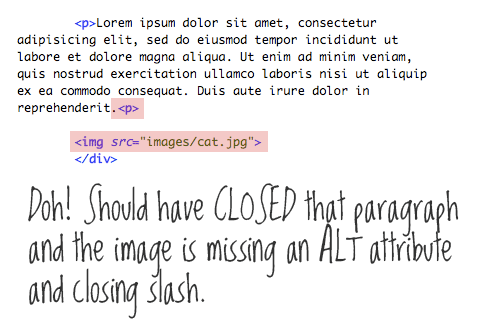
Let’s take a look at some poorly written HTML, discuss its problems, and then whip it into shape! Bear in mind, we are not passing any judgment on the content or design of this page, only the markup that builds it. If you are interested, take a peek at the bad code and the good code before we start so you can see the big picture. Now let’s start right at the top.
1. Strict DOCTYPE
If we are going to do this, let’s just do it right. No need for a discussion about whether to use HTML 4.01 or XHTML 1.0: both of them offer a strict version that will keep us nice and honest as we write our code.
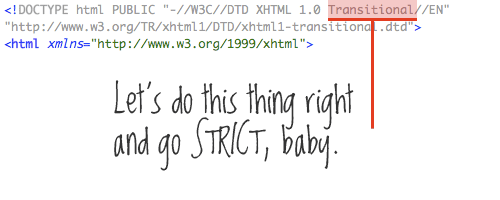
Our code doesn’t use any tables for layout anyway (nice!), so there really is no need for a transitional DOCTYPE.
Resources:
- W3C: Recommended DTDs to use in your Web document
- Fix Your Site With the Right DOCTYPE!
- No more Transitional DOCTYPEs, please
2. Character set & encoding characters
In our <head> section, the very first thing should be the declaration of our character set. We’re using UTF-8 here, which is swell, but it’s listed after our <title>. Let’s go ahead and move it up so that the browser knows what character set it’s dealing with before it starts reading any content at all.
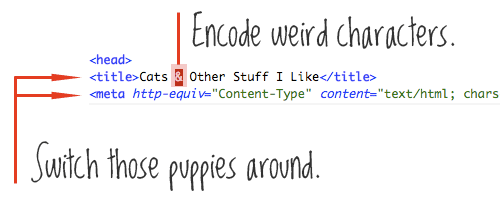
While we’re talking about characters, let’s go ahead and make sure any funny characters we are using are properly encoded. We have an ampersand in our title. To avoid any possible misinterpretation of that, we’ll convert it to & instead.
Resources:
3. Proper indentation
All right, we are about three lines in and I’m already annoyed by the lack of indentation. Indentation has no bearing on how the page is rendered, but it has a huge effect on the readability of the code. Standard procedure is to indent one tab (or a few spaces) when you are starting a new element that is a child element of the tag above it. Then move back in a tab when you are closing that element.
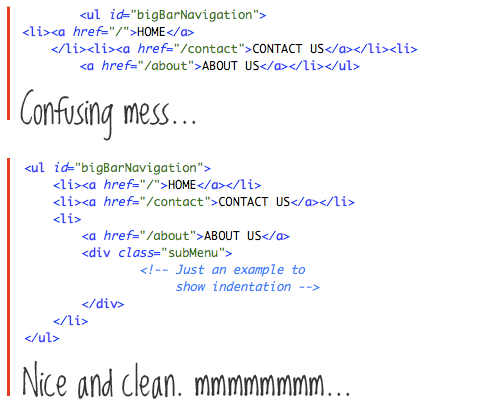
Indentation rules are far from set in stone; feel free to invent your own system. But I recommend being consistent with whatever you choose. Nicely indented markup goes a long way in beautifying your code and making it easy to read and jump around in.
Resources:
4. Keep your CSS and JavaScript external
We have some CSS that has snuck into our <head> section. This is a grievous foul because not only does it muddy our markup but it can only apply to this single HTML page. Keeping your CSS files separate means that future pages can link to them and use the same code, so changing the design on multiple pages becomes easy.
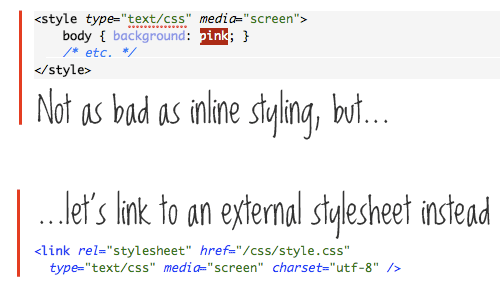
This may have happened as a “quick fix” at some point, which is understandable and happens to all of us, but let’s get that moved to a more appropriate place in an external file. There is no JavaScript in our head section, but the same goes for that.
5. Nest your tags properly
The title of our site, “My Cat Site,” is properly inside <h1> tags, which makes perfect sense. And as per the norm, the title is a link to the home page. However, the anchor link, <a>, wraps the header tags. Easy mistake. Most browsers will handle it fine, but technically it’s a no-no. An anchor link is an “inline” element, and header tags are “block” elements. Blocks shouldn’t go inside inline elements. It’s like crossing the streams in Ghostbusters. It’s just not a good idea.

6. Eliminate unnecessary divs
I don’t know who first coined it, but I love the term “divitis,” which refers to the overuse of divs in HTML markup. Sometime during the learning stages of Web design, people learn how to wrap elements in a div so that they can target them with CSS and apply styling. This leads to a proliferation of the div element and to their being used far too liberally in unnecessary places.
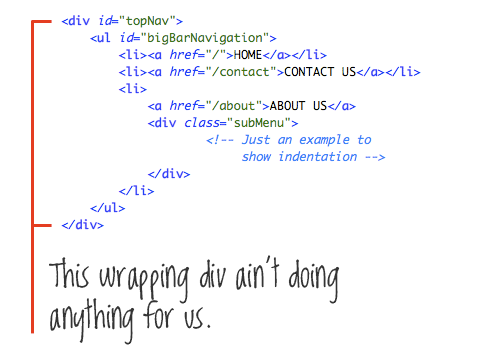
In our example, we have a div (“topNav”) that wraps an unordered list (“bigBarNavigation”). Both divs and unordered lists are block-level elements. There really is no need whatsoever for the <ul> to be wrapped in a div; anything you can do with that div you can do with the <ul>.
Resources:
7. Use better naming conventions
This is a good time to bring up naming conventions, as we have just talked about that unordered list with an id of “bigBarNavigation.” The “Navigation” part makes sense, because it’s describing the content that the list contains, but “big” and “Bar” describe the design not the content. It might make sense right now because the menu is a big bar, but if you change the design of the website (and, say, change the website navigation to a vertical style), that id name will be confusing and irrelevant.
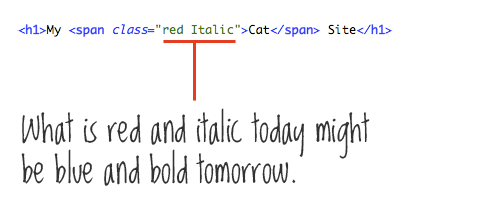
Good class and id names are things like “mainNav,” “subNav,” “sidebar,” “footer,” “metaData,” things that describe the content they contain. Bad class and id names are things that describe the design, like “bigBoldHeader,” “leftSidebar,” and “roundedBox.”
8. Leave typography to the CSS
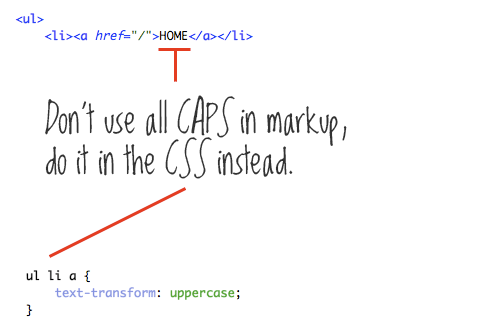
The design of our menu calls for all-caps text. We just dig how that looks, and more power to us. We have achieved this by putting the text in all-caps, which of course works; but for better, future extensibility, we should abstract typographic choices like this one to the CSS. We can easily target this text and turn it to all-caps with {text-transform: uppercase}. This means that down the road, if that all-caps look loses its charm, we can make one little change in the CSS to change it to regular lowercase text.
9. Class/id the <body>
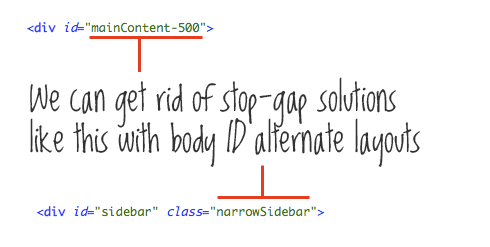
By “class the body,” I literally mean apply a class to the body, like <body class=”blogLayout”>. Why? I can see two things going on in this code that lead me to believe that this page has a layout that is different than other pages on the website. One, the main content div is id’d “mainContent-500.” Seems like someone had a “mainContent” div at one point and then needed to alter its size later on and, to do so, created a brand new id. I’m guessing it was to make it larger, because further in the code we see <class=”narrowSidebar”> applied to the sidebar, and we can infer that that was added to slim down the sidebar from its normal size.
This isn’t a very good long-term solution for alternate layouts. Instead, we should apply a class name to the body as suggested above. That will allow us to target both the “mainContent” and “sidebar” divs uniquely without the need for fancy new names or class additions.
Having unique class and id names for the body is very powerful and has many more uses than just for alternate layouts. Because every bit of page content lies in the “body” tag, you can uniquely target anything on any page with that hook; particularly useful for things like navigation and indicating current navigation, since you’ll know exactly what page you are on with that unique body class.
Resources:
10. Validate
Kind of goes without saying, but you should run your code through the ol’ validator machine to pick up small mistakes. Sometimes the mistakes will have no bearing on how the page renders, but some mistakes certainly will. Validated code is certain to outlive non-validated code.
If for no other reason, seeing that green text on the W3C validator tool just makes you feel good inside.
Resources:
- The W3C Markup Validation Service
- XHTML-CSS Validator
- Free Site Validator (checks entire site, not just one page)
11. Logical ordering
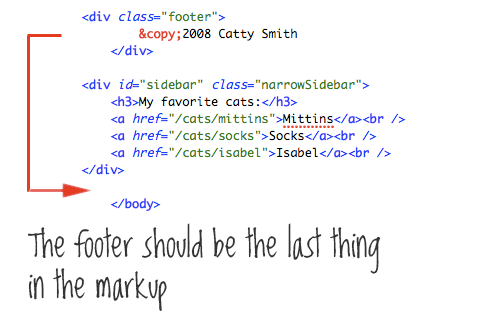
If it is at all possible, keeping the sections of your website in a logical order is best. Notice how the footer section lies above the sidebar in our code. This may be because it works best for the design of the website to keep that information just after the main content and out of the sidebar. Understandable, but if there is any way to get that footer markup down to be the last thing on the page and then use some kind of layout or positioning technique to visually put it where you need it, that is better.
12. Just do what you can
We’ve covered a lot here, and this is a great start to writing cleaner HTML, but there is so much more. When starting from scratch, all of this seems much easier. When trying to fix existing code, it feels a lot more difficult. You can get bogged down in a CMS that is forcing bad markup on you. Or, there could be just so many pages on your website that it’s hard to think of even where to begin. That’s OK! The important thing is that you learn how to write good HTML and that you stick with it.
The next time you write HTML, be it a small chunk in a huge website, or the beginning of a fresh new project, just do what you can to make it right.

(al)


Cotton
November 12th, 2008 3:13 pm13. Apply the concept of DRY to your websites — use includes for repeating code like navigation, footer, headers, etc.
14. Comment your closing div tags for when you come back to it in the future
**Most times when people don’t use logical ordering it is because they want the most important information at the top of the page for SEO reasons.
Richard
November 12th, 2008 3:17 pmGreat post!
What font did you use for the comments :-)
Joe
November 12th, 2008 3:18 pmJust curious, what font are you using for the comments in your images?
Johns Beharry
November 12th, 2008 3:18 pmFor some reason I dont really trust html tidy used it for the first time this weekend though. The whole automated thing sorta freaks me out.
And #2 that’s new to me thanks a lot.
Awesome article
Joel Heffner
November 12th, 2008 3:18 pm“Our code doesn’t use any tables for layout anyway (nice!)”
Nice…but…tables do allow us to center blocks on the screen very easily.
Michael
November 12th, 2008 3:21 pmSo does
div{margin:0 auto;}Serpico
October 31st, 2011 5:18 amYeah, but that’s not all, when using “margin:0 auto;”. One must also specify a fixed width of pixels or percentage in order for it to work, and the width must really create the space of the left and right margins of the styled element with equal values, meaning that both must have, for example, 200px. :)
All in all, I too believe is the best way to center elements within other elements or in a document, in a web page.
Rafyta
November 12th, 2008 3:26 pmCool… easy and well explained.
Chris Coyier
November 12th, 2008 3:26 pmRegarding the font, you’ll love this, it’s a freebie!
http://www.dafont.com/loved-by-the-king.font
Thanks for having me, Smashing Magazine =)
kocsmy
November 12th, 2008 3:26 pmreally nice and usefull tips. thank you interweb! :)
Parker
November 12th, 2008 3:27 pmI’ve given up on the Strict DOCTYPE. I used to be its biggest advocate, but it has become less and less viable to me. The reason: user-generated content. We’re well into Web 2.0 now, whatever that means. It’s the era of interaction. I can control my code and validate it and make it semantically perfect… but the minute a user types an ampersand into a comment box, the whole thing explodes. Not to mention mismatched, unclosed, or deprecated HTML tags.
I suppose if I got paid more I could bother to parse everything and convert characters to entities and figure out what to do with user-supplied HTML. That’s too big of a job to be feasible for me — I can’t anticipate every possible thing a user might type. With the Strict DOCTYPE, all it takes is one syntax error and the entire page fails most ungracefully. I can’t afford to let that happen on a modern dynamic site. Better to go with a Transitional DOCTYPE and let quirks mode deal with irregularities. Practicality wins out.
W3MasteR
November 12th, 2008 3:29 pmgreat for beginners
Tommy Day
November 12th, 2008 3:34 pmGreat tips, Chris.
I Hassen
November 12th, 2008 3:39 pmSomething really worth reading and extremely useful..as always Smashing Mag!
I love you guys.
Andrea
November 12th, 2008 3:41 pmGood post!
oh, and the link “W3 MARKUP” in the footer is ugly dead..
Raanan Avidor
November 12th, 2008 3:48 pmClose, but no cigar.
It is a right step in the right direction, but… (there is always a but)…
1) Since there should be only one
<h1>in a page it does not need an id and if you need to style the<h1>in a different way in different pages you can use the body id to identify the<h1>withbody#blogLayout h1{color:#f00}.2) in most designs the
<div id="topNav">is needless and the<ul>under it can be the hook for the CSS, on the other hand, if you do need the<div id="topNav">then you probably do not need the id in<ul id="bigBarNavigation">3) the name “topNav”, “bigBarNavigation”, “sidebar” and “footer” are problematic. The id of an element should describe its content not its position (top, side, foot) or style (big). Navigation is a good name, you can add mainNavigation, secondaryNavigation and copy as ids, now if you will change (with CSS) the position and/or style of the element the id will still describe its content.
David Hellmann
November 12th, 2008 3:51 pmGood Things! :D haha :)
Joe
November 12th, 2008 3:52 pmMuch thanks to Chris Coyier, the handwritten font is Loved by the King (a great $5 font by Kimberly Geswein).
Jason Newlin
November 12th, 2008 3:59 pmChris, great post. Really like the way you lay out the info, and explain in an easy to understand manner. Great stuff, nice work.
Albert
November 12th, 2008 4:03 pmGood article for Strict basic template building. Thanx
John Faulds
November 12th, 2008 4:12 pmOnly if you’re using an XHTML strict doctype and serving your page up as proper XHTML (mime type = application/xml+xhtml) with its more draconian error handling. And if you’re doing that then you’d need to be using content negotiation for IE anyway. XHTML served as text/html won’t fail badly and neither will HTML 4.0 pages. The pages might not validate, but they won’t fall apart. Sounds like you’re making things more difficult for yourself than they need to be.
Not necessarily. You might use a h1 for the title of your site on the site’s home page but on internal pages use the h1 as the page title with the site’s title then being wrapped in a different tag. Rather than have two style rules for each different element, if you give the site title an ID, you only need to write the rule once. It also means that on internal pages that if you use a <p> or <div> for the site title that it won’t get confused with other similar elements in the header.
ashorlivs
November 12th, 2008 4:17 pmSo you guys do not draw tabular datas into tables?
Gosh…
James
November 12th, 2008 4:58 pmGreat post Chris, thanks.
Derek McDonald
November 12th, 2008 5:01 pmI love clean code and whenever I develop anything I always make sure the code is readable and well commented. I find that it helps to have clean code to easily fix problems that may occur when the code is rendered.
Great list of helpful tips there but don’t forget people that both javascript and css also need to be nice and clean too.
Juan Pablo
November 12th, 2008 5:24 pmGreat article. Thanks.
Louise Huntley
November 12th, 2008 6:05 pmGreat list, but I also disagree (somewhat) in regards to the naming conventions. “Sidebar” and “footer” have become so popular that we tend to forget that they are actually describing the style, or at least the layout more than they describe the content.
Consider what content is going to go into those sections and name them accordingly. Try “secondary-content” or “supporting-information” or “calls-to-action” for “sidebar”, and “company-information” or “legal” for the footer.
I’d also go so far as to say that “container”, another very popular class/id name, is also layout specific and should probably be replaced with the name of your website – div id=”www.mysite.com”.
terrell
November 12th, 2008 6:06 pm@Parker
You should be sanitizing user input anyway so if a wayward & slips by you that is your fault. An ampersand is mos’ def’ a quite common replacement for and.
Patareco
November 12th, 2008 6:10 pmNice article Chris! I once was guilty of all these! But i’m improving thanks to you and other bloggers around the web!
@parker
If you use php you can simply use the htmlspecialchars() function, which cleans all the special chars LOL
erbag
November 12th, 2008 6:33 pmChris excellent article. You covered all the major points.
Chris Loft
November 12th, 2008 6:50 pmExcellent. Thank you. I make many of these mistakes – (past tense}.
mikemike
November 12th, 2008 7:16 pmVery weak. Strict still validates when using tables for layout. The difference is that in Strict you cannot declare css values as attributes
example:
I'm a div tag
Kyle
November 12th, 2008 7:17 pmThis was an excellent post. Well written, and very informative.
mikemike
November 12th, 2008 7:18 pmWow, nice blog – it doesn’t even encode my (x)html – let’s try this again:
example:
<div align="center">I'm a div tag</div>
Lee
November 12th, 2008 7:37 pmI actually disagree with a lot of the content. You know why people use tables to layout content? Because it’s intuitive, simple and self contained. While there’s a lot of merit in code isolation (particularly for re-use and robustness), there is little reason for many people to use CSS to layout their page.
Another reason for code going directly into files is Dreamweaver and you know what – it works and people don’t care, in fact, why should they?
I agree with points 3 and 11 on formatting code, but as another newsflash – people were doing this before blogs were around to tell them about it. In fact in my first year studying Computer Science at uni, I got marks for code style – formatting, indenting, comments. I’m also a fan of verbose variable names – take a look at Apple’s extensive design guidelines for more examples of that.
Matt
November 12th, 2008 7:45 pmThe
{text-transform: uppercase;}property works great for English text, but fails to transform foreign characters (such as ö -> Ö, å -> Å) for other languages.zorb
November 12th, 2008 8:00 pmPOO!
David
November 12th, 2008 8:09 pmI disagree with #7, there is nothing wrong with the class “Red” if it is defined as { color: red; }. In that instance, it is the most descriptive it can be, and if you change your design, you wouldn’t change it to be defined differently, you would apply “Blue” as a class instead.
As an ID name, I agree with you that Navigation or footer should be specific to what they are, but a class name is something that can be applied to many elements, and should define the class. What is the common denominator of every element of the class? Well, in that instance, every instance of the “Red” class will be red, so why is that a worse name than describing the content?
Anna
November 12th, 2008 8:12 pm@Lee… What is so intuitive about tons of spacer.gif graphics (you normally see ton of those when site is designed with tables)? Learn how to layout pages with CSS, and leave tables for tabular data. Just MHO.
James Smith
November 12th, 2008 8:23 pmI was advocating “STRICT” XHTML until I hit the biggest snag – file upload in AJAX enabled websites – still requires an IFRAME which isn’t allowed in XHTML strict…. unfortunately the workaround – OBJECT – doesn’t offer the same functionality as IFRAME… in this one instance.!
Philip
November 12th, 2008 8:52 pmNice article, good refresher for somebody who is coming back from a mini-vacation ;)
I’ve seen more and more of these bad practices put into place. Especially ones like #6 & #7. Although, to add onto #7 I would prefer to name it based off the type of color it is – primary, highlight, shadows, etc in addition to what it is (subNav)
Validating your markup is a bit, well, overrated. When some browsers *cough* IE *cough* still don’t display the page correctly, even when everything is valid – what’s the point of going the extra mile? Now, I do think that web pages need to be properly coded – like properly closing tags & attributes.
P.S. – Did you ever look at SM’s css? “#leftcolumn”, “#footer .foologo” foo? Seriously?
Sam
November 12th, 2008 9:00 pmI’ve been doing these ever since i began, and i get all of my friends who are starting to codelike this aswell, it just looks soo much better.
And i agree, that little green text does give a nice warm feeling :)
Simon Ong
November 12th, 2008 9:19 pmNice post! This will guide me even further in making web designs in the future!
Thanks!
Neil
November 12th, 2008 9:22 pmCompletely disagree with 4, I’m getting very tired of sites loading without styles or JavaScript whenever there’s a glitch with the connection! The correct approach would be to keep the important code in the header (from a server side include) and use an external file for all the extras.
Nitesh (Web Designer)
November 12th, 2008 10:07 pmWell explained.. cleared concepts of writing new html code… 10 out of 10 marks…
Bomnun
November 12th, 2008 10:09 pmNice post! Thanks.
Mukesh
November 12th, 2008 10:19 pmIt’s nice…….but very difficult to apply STRICT markup……when we are working on CMS’s…………end user doesn’t think about this..
Well it’s nice post!
Thanks!
h-a-r-v
November 12th, 2008 10:38 pmI agree upon Strict but Transitional may be needed when e.g. using iframes (like Google map). It shall fade into the past when object finally renders properly in most browsers, but not today.. not today.
And I believe 10. consists 5. (any validation points badly nested tags, right? – of course the rules should be applied while coding – it measures our skill and saves time – but if validation is mentioned I guess it serves a higher purpose than just pointing badly ended tags).
Angelos
November 12th, 2008 10:57 pmHEALTH ADVISORY: “Non-acute Divitis can also be an advantage in the long term”
Allow me to present a relatively weak but sound argument for the benefits of issue 6: Indeed, “Divitis” can result in a proliferation of div tags, and a lengthier HTML code. However, one long term benefit of the disease is the fact that the wrapping div can act as a great facilitator when using javascript frameworks (mootools, jquery, prototype).
Having named divs wrapping interface elements (even if the div does not server any CSS purpose) can sometimes be a good thing. It will allow the developer to easily implement future JS framework goodness (slides, arbitrary selections, animation etc) without the need to re-edit the code or worry whether the ul element has defined dimensions, is absolutely or relatively positioned, IE’s hasLayout is applied etc, etc.
Indeed, in the example presented, there’s no need to keep div id=”topNav” since if we need to refer to the li or a tags of the nested ul we can simply use $(‘bigBarNavigation’). However, if in the future we wanted to play around with the idea of a sliding or revealing menu, and if we assumed that topNav is a styled menu with display:inline or float:left li elements, it would be easier to apply the animation to the topNav div instead of the bigBarNavigation ul (despite the fact that it’s a block level element).
Just my 2 cents…
BWPanda
November 12th, 2008 11:15 pmGreat article! Back to basics.
Javi
November 12th, 2008 11:33 pmBasic but nice post.
Thanks!
Alpay
November 12th, 2008 11:37 pmThanks man, great article. Saved in my bookmarks…
Shuuun
November 13th, 2008 12:12 amJeah, pretty cool!
All newbies will love this ;)
I will show this article some of my trainies!
Ani López
November 13th, 2008 12:26 amAbout ’11. Logical ordering’
what you mean by ‘logical order’, visual one? I meam:
1- Header
2- Content
3- Columm
4- Footer
this is the order while displaying the web but for SEO purposes (place the main content up as possible in markup) the logical order can be:
1- Content
2- Columm
3- Footer
4- Header
Yes, it can confuse a bit while working it but remember that uploading a web to server and make it alive is not the last step, is just the begining of the adventure and search engines are going to crawl your site so better serve it the best way or your work will be for nothing in most of the cases.
Jonny Haynes
November 13th, 2008 12:33 am@Parker control the user output so that it validates to a STRICT doctype. Don’t just fall back to a TRANSITIONAL doctype. That’s just plain lazy.
@Mukesh What CMS? If you’re using one that won’t produce valid code or a STRICT doctype get rid immediately. Again that’s just being lazy.
@David
That’s just daft – now you’ve got to go back through your 2 million page website and remove class=”red”. If you gave it a more descriptive name , then you’d only have to change the colour in the CSS. Or don’t give it a class at all!
The whole point of using CSS and X/HTML is to reduce the markup in your X/HTML – so utilise as many of the built in features as possible. See example:
div
ul
li one
li two
li a three
Would you give the anchor a class of red? Why? Wouldn’t this be better? You could style it like this?
div ul a {
color: red;
}
You’ve then only got to change the CSS, utilising the power of CSS and X/HTML.
Rene Schmidt
November 13th, 2008 12:37 amGood vibes here
Aaron
November 13th, 2008 12:41 amA very usefull article, thanks!
Banelicious
November 13th, 2008 12:55 amAwesome post, really nice to read with some interesting points in it…
begs
November 13th, 2008 12:57 am@Lee #30: Let go the 90′s – It’s 2008 now!
Nice article though!
Ronald Lokers
November 13th, 2008 1:05 amGreat post, it totally aproves that I work the right way :)
Leannekera
November 13th, 2008 1:17 amAs a 5 year CSS bod myself I have to say that this must be the best Smashing article on CSS for beginners I have read to date.
Good job old chap!
Max B.
November 13th, 2008 1:17 amStating the obvious?!
It’s funny to watch the same stuff over and over again.
Seriously most of these practices have vanished the last years.
There’re always going to be some guys using tables, coz they are convinced that’s the way to go. You’re not going to convince those ppl by labeling tables as “bad practices” without proper reasoning. And there are indeed as many positive as negative points for both sides.
The only reason why people should adjust to CSS is because while tables have reached their potential, CSS is still getting improved.
@David – Can you imagine having a large-scale website and editing every single class attribute when there’s about a thousand of them…well you might, but you gotta agree it’d be easier to just edit some properties in the CSS file. And there’s no proper reasoning why you wouldn’t use a classname with meaning. If everything important for example is red…use important as a class name…why wouldn’ t you?
Hopefully CSS3 or something else is coming out soon, otherwise we’ll keep reading these “good practices”-fillers as long as there is nothing new to write about on the Web.
Michael Taylor
November 13th, 2008 1:30 amHahaha
Quality analogy.
Most of the points are just common sense but #8 is a new concept to me, I’ve never thought of using the CSS to change the case of text before, thanks for the informative post.
george
November 13th, 2008 1:52 amdiv in li? you gotta be kidding.
AL
November 13th, 2008 2:05 amAwesome post! #5 was an eye opener!
Schmoo
November 13th, 2008 2:10 amModerate divitis is not to be feared – it is entirely compatible with the whole point of CSS, separating content and presentation, and should be welcomed. If you’re changing layout somewhere down the line, you may well need another containing div in order to add additional layout behaviour, not to mention avoiding buggy browser behaviour. If you have to go back and add these extra divs to your XHTML, that’s a failure in the very principle you’re advocating the use of CSS for. You need look no further than the Zen Garden to see this demonstrated perfectly – they even make a note to that effect in their guidelines for contributors.
Hubbers
November 13th, 2008 2:15 amExcellent article.
Adam Clark
November 13th, 2008 2:18 amLets not forget that properly formatted, streamlined code is also more compact in file size and nicer to the world!
Excellent article. Well written and presented. It’s about time we had articles of this quality on smashing magazine. Don’t get me wrong, posts about “The 50 most beautiful this and that” are all well and good for inspiration but articles on good practise are also a great tool to have. Keep up the good work and I hope it helps make the HTML world a cleaner, more logcal place to work in.
Francesco Camarlinghi
November 13th, 2008 2:20 amNice post for beginners. Another good principle is to use lists (both ordered and unordered) when possible instead of divs. E.g.: a menu can be done with an ul element as it is a list of links, same goes for a category list, a post list, etc. The list of cats (#12) should have been done in that way too.
- Francesco
Dirar
November 13th, 2008 3:02 amFor a fast validation check this ff plugin: Html Validator
Mike Archibald
November 13th, 2008 3:15 amGreat post! I can check 9 out of 10 most of the time, but it did remind my of one small point I’ve been forgetting and that’s to use text-transform: uppercase;
Carrie
November 13th, 2008 3:20 amWhat font are you using for the handwritten comments?
Nice post!
Riccardo
November 13th, 2008 3:40 amA useful and well written article. Thanks!
You also included some great resource links and made me laugh a few times, too! (“It’s like crossing the streams in Ghostbusters. It’s just not a good idea.” Heh!)
Chin
November 13th, 2008 3:58 amFantastic post
Marcel
November 13th, 2008 4:07 amit is a great list…!
let’s do it strict baby ;)
Anjhero
November 13th, 2008 4:41 amsimple stuffs but very useful!
Bruno Alberto Byington Neto De Figueiredo
November 13th, 2008 4:48 amawww, so cute. Im one of those Geeks who went from XHTML and CSS to DHTML to Pythong (Django) and its always such a pleasure to get to know people who dig standards as I always tried to. Feel umarmed and together our creative geeky but powerful network will rise.
sorry Im feeling kind of emotional,
Bruno
Javier Tapia
November 13th, 2008 5:03 amThe #8 rule must be applied to the #3 example (uppercase text). ;-)
Great article. Thanks
insicdesigns
November 13th, 2008 5:13 amvery informative article.
Timothy
November 13th, 2008 5:48 amI don’t really agree with the body id thing. Or maybe I am thinking of this the wrong way. Can’t you just write
body #div1 {
}
body #div2 {
}
???
Other than that I completely agree with the other topics. Good work!
Manko10
November 13th, 2008 5:55 amVery nice article, Chris!
I’m really glad about your first rule because I see more and more Transitional Doctypes but I don’t know why it’s used, no reason for doing that. Transitional is a Doctype for the transition between old and new Markup, it’s been developed to be mostly compatible but it’s not for new websites.
On my own website I’ve written an article about the same issue and now I’m very pleased to see it on a very huge blog. May it help to make the Web better! ;-)
Thanks!
WebUnicorn
November 13th, 2008 5:59 amnice article
i wish you make another one on DOCTYPEs
tobias
November 13th, 2008 6:01 amI agree that if something looks clean and slick, most of the time it is slick.
However, I’ve heard enough of people trying to tell me that something is just “bad practice” only because it’s engraved in the holy grail of web design. That sounds quite religious..
If something works for the majority of users , it’s good practice.
Sorin
November 13th, 2008 6:08 amNice article …
I would suggest to optimize your images (smush.it) – for people who don’t it’s the best tool for optimizing your images
And also measure your site with YSlow, see how fast it is, what you did wrong and what you did good and how to improve it
All these … thanks to yahoo and Stoyan S.
Ian
November 13th, 2008 6:19 amGreat Article Chris! I will start using strict from now on in my client’s websites…
Web Major
November 13th, 2008 6:43 amI just wrote an article on standards yesterday, because of a discussion on how tables are easier for layout than css on Reddit.
To those of you who are still using table based layouts… you’re one of the following:
1. Lazy
2. Unprofessional
3. A backend programmer who is set in their old ways.
4. A designer who doesn’t care to learn.
5. An amateur front-end coder.
Any front-end guy worth their salt hasn’t touched a table based layout in years.
Alex
November 13th, 2008 6:45 amThanks Smashi! :-)
Jason
November 13th, 2008 6:56 amOn point 11, it might be interesting to put the menu at the bottom of the code and the put it on the top of the page with CSS. This will be good for your referencing. But maybe not for people who use text-readers browsers… Have fun !
lica
November 13th, 2008 7:05 amWhat I really liked about this article was the comments. It’s nice to hear other peoples opinions. Sometimes there really is two ways of doing the same thing. Thanks!
heather van de mark
November 13th, 2008 7:10 amI haven’t finished reading this article yet, but props for the handwritten script. It really makes this more interesting to read/look at visually. Thank you for not making this boring, otherwise I would have skipped right over it!
Carlos
November 13th, 2008 7:15 amNice post, grats!
Davin
November 13th, 2008 7:20 am@20
Not necessarily. You might use a h1 for the title of your site on the site’s home page but on internal pages use the h1 as the page title with the site’s title then being wrapped in a different tag. Rather than have two style rules for each different element, if you give the site title an ID, you only need to write the rule once. It also means that on internal pages that if you use a p or div for the site title that it won’t get confused with other similar elements in the header.
One of the authors key points was to define a class for body, so you can distinguish the content styling for h1 ones using the body class. This way you still only have one h1 per page.
body.main h1body.home h1
divotdave
November 13th, 2008 7:20 amReal Quick on the DOCTYPE thingy – Transitional is not always a bad choice – you have to consider sites that might need to embed code (i.e. YouTube videos, etc.) from a third-party site that may not be Strict compliant and will break validation tests in Strict. Another example might be a site that depends on an underlying CMS.
Also, many of the popular Javascript libraries (i.e. MooTools, JQuery, et al) are intended to work with XHTML – so there is a good reason at times to pick that over just plain old HTML.
lilott
November 13th, 2008 7:32 amIronically enough, there are 14 errors when you validate this page….violation of number 10.
Chris
November 13th, 2008 7:32 amGreat post. I practice most of these regularly, but every once in a while I find my code getting sloppy. It’s always good to go back and reinforce good habits.
Beginning HTML/CSS coders take heed!
Sai Gudigundla
November 13th, 2008 7:41 amThanks for yet another great article.
divitis
November 13th, 2008 7:45 amHow come Smashing Magazine doesn’t practice what they preach? On this very page where you promote clean code, you are breaking many of the rules you outline above.
1. Doc Type is XHTML 1.0 Transitional
2. Outputs 16 Validation Errors
3. Majority of Code not Indented
4. Lots of inline JavaScript
itpinoy
November 13th, 2008 7:47 amnice post! unlike before where we just manually type everything, right now with the influx of tools that automatically generates html/css, i see this to be a challenge. it would be good practice to follow this esp when you’re in a consulting company and you’ll eventually transition your codes to another person, following a standard, and having a clean code (plus proper docos) is always a good practice!
Jeremy Nicoll
November 13th, 2008 7:50 amMichael: CSS currently does not allow for vertical alignment for block level elements except for TD’s. So if you want something centered vertically on your page your only option is to use a table – or if you are centering a single-line inline element, you can fake it by setting line-height.
Paras Jain
November 13th, 2008 7:53 amGood post !!
Brad
November 13th, 2008 7:59 amIronic how this article’s own page is transitional and not strict!
Joost
November 13th, 2008 8:02 amI can really see how most of your tips are useful. I agree with most of them. However I don’t think it’s good to say that you can not, of should not use unlinked JavaScript / CSS. There is a reason when you should use CSS / JavaScript internal:
View source of yahoo.com, all CSS and JavaScript (well, most) is included in the index file. I have heard Nate Koechley speak on why yahoo did such a thing, it all had to do with loading time of the page. Every CSS/JavaScript file is an other server request. And if you are having a lot of traffic on your site (which yahoo, of course, does) than it pais not to link to it but render it into the HTML file.
So, there you have it, someone elses point ;-) For me it’s not a good idea to have internal CSS/JavaScript, just because I don’t have a high traffic site. But, if you do, it’s worth a shot!
Josso
November 13th, 2008 8:16 amVery nice article…
- Josso
E to the G
November 13th, 2008 8:32 am*YAWN* Can we please stop calling CSS and HTML “code”. HTML = HyperText Markup Language – It’s a MARK UP LANGUAGE!!!!!!!!! There’s is no logic to CSS and HTML layouts, Puuuleeeezzzeeee – C is code, Perl is code, PHP is code, XCode is code, Java is code, Javascript is code — hey u guys really want to build a web page using Code – use Javascript – all this self patting in the back for what any 6th grader taking a computer science class can do using DreamWeaver is ridiculous. Those who create their pages using VI, VIM, PICO, Notepad or any text editor are a step up above you clowns but still by no means are they “coders”. WHen you guys start buiding insane web applications that combine CSS, HTML, Javascript, PHP, back end chron scripts, integrating C code into your PHP build, MySQL, FLEX, Actionscript cohesively – then, then maybe you can start discussin the merits of “clean code” as it it applies to web development not just simply laying out a pretty web page in photoshop, slicing the images, and then using CSS and HTML to lay them out—- thats not coding— not code — code it is not.
Bernhard H.
November 13th, 2008 8:35 am@Matt.
I use {text-transform: uppercase;} often, and most webbrowsers do this pretty good: In Firefox it’s not only transforming the umlauts but even ß to SS.
@ E to hte G
I think it’s cron not chron, isn’t it?
Alan
November 13th, 2008 8:42 amUnless you’re working on a small website, validation is not compulsory, otherwise you’re gonna end crazy trying to correct all errors.
I’d say, if you keep only one rule from the twelves, it is #5
Remember that you want your website to work well in IE, Firefox and Safari. So I’d advice to test your page on multiple browser long before taking care of details like encoding characters
And having well nesting tags (rule #5) helps a lot when it comes to make your page multi-browser compliant.
Peter
November 13th, 2008 8:48 ammainContent-500 is not a semantic class name – it’s as bad as “red italic”, used as an example by you earlier.
Linda
November 13th, 2008 8:50 am@E to the G
Actually I wouldn’t call Javascript “code” either. It’s a scripting language. Script, not code. But a lot of the same “good practices” applies to both script and code. And even mark-up.
And if you think there’s no logic to HTML then you’re doing somethng wrong… HTML should be semantic
kiplog
November 13th, 2008 8:51 amJeremy: tables aren’t the only option for vertically centering elements – a combination of nesting absolute and relative positioned elements, and a top: 50%; works, although admittedly it is harder to explain how to pull it off than valign=”center”.
Chris Luckhardt
November 13th, 2008 8:52 am@John Faulds
Using one
H1tag is a generally accepted SEO practice. It optimizes your search results and clarifies what the actual page title is.E to the G
November 13th, 2008 9:07 amLinda OMG are you seriously saying semantic HTML is somehow tied into logic – Logic for me means trying to figure out the precise, correct method for handling use case scenaraios as they pertain to an application. It’s about writing re-usable code that passes unit testing. It’s figuring out the flow of the processes and figuring out all the multiple instances in which that processes might break and fixing that – logic does not meant using “cite” in place of “i” for emphasizing the title of a book in HTML. That’s just good sense, that’s just following W3C standards. Oh and calling Javascript a “scripting” language is correct, but what I meant to say is that you can PROGRAM in javascript which makes it code. Can you program in HTML?
Robin
November 13th, 2008 9:08 amI find that the most common reason for a ‘divitus’ wrapper on unordered / ordered lists is because each browser has it’s own formatting (margins, padding, etc) on lists. I wouldn’t trust the <ul> tag on it’s own in my layout. What’s more, the ‘div’ tag should be used to divide a section from the rest of the layout / content, and if you’re making a navigation section, that’s usually put in a ‘div’ as it’s more likely than not containing more elements than just an unordered list.
Josh Highland
November 13th, 2008 9:11 amgreat post. I agree with all the point that you made. I would also like to insert a new point on avoiding CSS hacks for specific browsers/versions. If you need hacks, odds are your doing something un-needed.
Pothi
November 13th, 2008 9:32 amHi Chris,
Thank you so much for sharing these points. I’m a beginner in web development/design. Pretty useful.
Thanks again.
tylerv
November 13th, 2008 9:50 amretard stuff for beginners. thanks for wasting my time
gr8pixel
November 13th, 2008 10:02 amexcellent post. thanks a lot for sharing!
Fredrik Carlsson
November 13th, 2008 10:13 am…about #2
I read somewhere that using the title tag first gives a small bump with search engines and since reloading a few lines is not that big a deal, you should go with title first.
Anyone know if this is true?
bigyaz
November 13th, 2008 10:15 am“great for beginners”
Why are there so many douchebags who feel the need to make it clear that they are *so* much more advanced than this mundane post. Grow up, children!
Deron Sizemore
November 13th, 2008 10:18 amIt’s not overrated if you just take it is. Validating your code isn’t there to help you achieve cross browser compatibility, it’s there to help you clean up your code. It’s entirely possible to create a new .html page with 100% valid code an have it display horribly (and differently) in different browsers.
MrPoopyPants
November 13th, 2008 10:19 amLet’s examine the site this is stated on:
1. Doc type: XHTML 1.0 Transitional
3. Uh, check the indention of this site…
4. Lots and lots of inline styling
5. Didn’t want to check for badly properly tags
9. Hrmp… the id of the body element is ‘css’… good choice of name and what is this that is just after ?
Dan
November 13th, 2008 10:24 amGood stuff, I think #1 is a bit misleading though… probably at least 95% of sites that use XHTML strict actually aren’t serving it up to specification… so in an attempt to adapt the latest standards and follow everything to the letter, it turns out to be fairly counterproductive… HTML strict could work though, but I opt for XHTML transitional (even though I write strict code), for the simple reason that some browsers (namely IE) won’t even render the page if the XHTML specifications are strictly followed.
Kieron Hughes
November 13th, 2008 10:26 amFantastic article. Very helpful. Cheers.
Ian
November 13th, 2008 10:33 amThis is a fantastic post and really helps a lot.
Unfortunately it serves equally to inflate the massive ego of those who are no longer beginners and therefore do not need the information which they once did, like others do now. They really should grow up. Regardless of their skills, they are just proving themselves to be a total waste of space.
chelle
November 13th, 2008 10:37 amWhat a beautiful and easy way to present your point! I totally loved reading through this and had to say it even though usually I am a full on lurker.
xNephilimx
November 13th, 2008 10:44 amNice article, I found it very usefull for some friends that are in charge of doing the markup in a project of ours.
Anyway, I don’t agree with giving the body an id/class, when you have a site that uses the same (or almost) header and footer, it’s a really good practice to keep those files separate in a folder, like includes, so you can include them in the pages that uses them, so the body tag and sometimes even the navigation (and maybe some other stuff) is left in the header file.
Despite that, I think is a good article for beginners.
Alex
November 13th, 2008 11:03 amNice article, although I have a few points regarding tables:
Tables are allowed in Strict XHTML, they’re not disallowed in any instance to do with code validation. They are however frowned upon when used for layout, as they can present an accessibility issue. Non-tabular content displayed in tables for a screen reader means it could get read out in a very different order than it appears on the page. Having multiple table columns with large amounts of content in each could mean it doesn’t display correctly on Mobile Devices, or can’t fit on an A4 piece of paper when printed. There’s many reasons why table tags should not abuse, even though it can make construction of HTML templates much easier.
d34dh0r53
November 13th, 2008 11:45 amfind ./ -name *.html -exec sed -i 's/class=\"red\"/color=\"blue\"/g' {} \;Will replace all occurences of
class="red"withclass="blue"Learn how to use the fundamental tools and your life will be a lot easier. I do agree that
class="red"is a bad idea BTW.ntopics
November 13th, 2008 12:05 pmThese are great hints to writing code well.
They will keep my code clean for sure.
Thomas Dedericks
November 13th, 2008 12:20 pmHi. Nice post, but I have to disagree on some points.
Rule 1 seems unrealistic to me. When you work for a client, you have to accept some constraints. What will you do if he wants some links to open in a new window ? Beat him with your laptop because it’s a bad pratice ? Use JavaScript to open a new window (eeeeek) ?
Sometimes, transitional doctype is just the right choice. And there’s nothing wrong about that. Keep your HTML clean, use CSS styles and document everything correctly. Who cares if your doctype isn’t strict, really ?
Rules 2 & 5 aren’t needed if you apply #10 ;)
Audra
November 13th, 2008 12:42 pmThis article was just what I was looking for! Very Helpful! :]
Adela
November 13th, 2008 12:51 pmYour advertisement columns are ridiculous. On a normal width browser window they take up half of the screen! It blocks out your nice article on how to design webpages…
anonymous
November 13th, 2008 1:18 pmYou seem to have confused markup language with code.
html != code
Joe
November 13th, 2008 1:35 pmSeems like someone is really eager to get their article listed on digg. This article has all the symptoms…
Kevin Watson
November 13th, 2008 1:41 pmThank you for taking the time to create this article. While some of the experienced persons replying think this was a waste of their time…others of us find it encouraging that there are references out there to help the infants of the group find their legs, and learn to walk properly without dragging a limb behind them. It also helps us all to review the basics on occasion, to ensure we aren’t straying from the path.
While I don’t agree with all of your points, as someone who has been working with web markup/scripting/coding/et al. since BLINK was a pup, the theme that one should always follow a set of standards cannot be drummed upon enough. Far too often, I find myself cringing when I open the pages created by my predecessor, because it is inconsistent, poorly formatted, has no thought process applied to layout and for a myriad of other reasons. If you are unable to apply basic rules to your coding style in the most basic pages, then once server side languages such as PHP are interjected, your code will degrade even faster.
Max
November 13th, 2008 2:20 pmYou forgot the golden rule:
If you are smart, use tables instead of CSS for layouts…then you can get back to making shit instead of dealing with shotty implementations.
Jacob
November 13th, 2008 2:29 pmI’ll have to disagree with “11. Logical ordering”.
See, when Search Engines scan your page for content, they look at your code from top to bottom. This is why you want the parts of your code containing your most keywords to be at the top.
True, it seems more logical to have your #footer at the bottom, but sometimes for SEO purpose it is better to have it right after your and then using CSS, place it at the bottom of your page.
Then again, like the last point says, do what you can!
Kelly
November 13th, 2008 2:35 pm1) No “format for print” option = epic fail.
2) Fully half your blog content area devoted to something other than actual content = weak.
Good article though.
Carlos
November 13th, 2008 3:08 pmYes this article is basic for most Computer Programmers who deal with C, Perl, JavaScript, PHP, ASP, and other back end total scripting and coding languages. For those who do not use those languages, who do not have the need for databases or hard core programming languages, these are meant to be useful for general mark up.
No it does not apply to the hard core coders and programmers. It is not meant to be. If you know all that stuff more power to you. No, actually, not more power, just good for you for being able to knowing those languages.
But going to a post that is supposed to help people, then completely bashing it because it is not a hardcore programming article is not called for. These may be basic principles, but that is all they are meant to be. Some people may agree or disagree with some of this stuff. So be it. If you take something good away from it than it served its purpose. If not then go on doing what you do. Don’t go on here, bash people and fight over it. That is just stupid and childish.
Dan Gayle
November 13th, 2008 3:10 pmRE: “Moderate divitis is not to be feared”
Even Dave Shea says that they would do things differently now. When they created the Zen Garden, the CSS landscape looked different, and they didn’t have the tools/techniques that we take for granted now.
RE: Styles/Javascript in the header
An additional reason to keep the javascript/css external is that it can then be cached, saving additional load times for internal pages.
And if everyone hot linked to Google for their jQuery, everyone would have the same item in their cache, speeding up the intarwebs for everyone.
bakaladaka
November 13th, 2008 4:04 pmoh great another newbie tutorial on what not to do. How about some actual useful items?
Dan Beeston
November 13th, 2008 4:20 pm@ David Well, in that instance, every instance of the “Red” class will be red, so why is that a worse name than describing the content?
Your HTML should be semantic, meaning you want to describe your classes in a way that explains why it’s red. Is it red because it’s an alert?
class='alert'. Or is it red because it’s an extra important link?class='important'.My question relates to the order of your content. Semantically should you put the navigation before or after the content. The content is what the reader is on the page for and for those browsing on mobile devices it makes it much easier.
Yesman
November 13th, 2008 4:46 pmA lot sites on the net use rendered output which may be messy, but who cares, your there to use the site not inspect the code behind.
Setting DOCTYPE to strict is silly.
The best rule to follow is, if it displays and works properly in all major browsers then your done. Following a strict standard does nothing for you.
Ara Abcarians
November 13th, 2008 5:16 pmlol Jonny Haynes, you said everything I wanted to say.
It’s amazing how most people’s excuses are “It’s too hard”
It’s even more amazing how people are actually arguing that using tables to design a layout is the smarter way to go. Lol Mainly because they are lazy.
Amazing, simply amazing. Read a book people.
Yesman
November 13th, 2008 5:22 pmPeople follow people.
A few people say don’t use tables, then some more people follow eventually opinions change. You silly sheep!
累了
November 13th, 2008 5:59 pm标题很好很强大,内容很黄很暴力
Patrick
November 13th, 2008 7:08 pmEnough with validation
Validation is bullshit in a finished site.
While I strongly advocate validation when building the site (that missing closing brace just might be wiping out your css), I believe that a site that’s gone live should always have perfect validation. Validations are guidelines, not laws.
I’m sick of people who must validate. It constrains people and limits freedom. Say you want to use CSS3 attributes for an added effect or just to get a browser to behave. Why throw it away for something as silly as validation?
Strict adherence to rules -> no change
With no change there’s no innovation
Look at the empirics. Almost no successful site validates, especially if you validate them based on Strict validation.
And I laugh at people who tell others not to use tables. Think of the new web designers. You tell them tables are a sin and they will never use tables again. When they want to make a calendar they will make it a mess full of divs. When they want to show tabular data the html will be barely comprehensible. I design using CSS layouts by choice because tables are too rigid. CSS is flexible. I can throw elements all over the browser window using CSS. But you know what’s a bitch? Equal height columns. Table layouts made many things easy. CSS just brings more benefits.
test
November 13th, 2008 7:41 pmsdsdsdsdsd
are you kidding me?
November 13th, 2008 7:58 pmthis entire post is common sense.
the title of this article should have been, “how to code front-end markup for n00bz 101″.
i applaud the effort, but this list of 12 could’ve been a lot shorter.
Danc
November 13th, 2008 9:48 pmI’m confused on point 6. Eliminate unnecessary divs.
Isn’t the top div a hold for the Navigation bar?
I checked Chris website, he is doing the same as what he’s written here in the sample.
Did I miss out anything?
Can anyone remind me on this?
Thanks
Sheilla
November 13th, 2008 11:29 pmNice pointers! But why is this website still using a transitional doc type?
Kris Leo
November 14th, 2008 4:02 amExcellent article! Thank you
Manohar
November 14th, 2008 4:06 amcan u tell me “!important” in css
how it will use
Manko10
November 14th, 2008 4:08 am@E to the G: why shall we stop calling HTML code? Well, it’s not a programming language but it’s still code. Code is just a rule for converting information into another kind of information and it has nothing to do with logic. So HTML, XML, CSS, JSON, LaTEX, RTF and ODF are code. ASCII, UTF-8, ISO-8859-1 etc.are code as well. Everything is code. ;-)
Bob
November 14th, 2008 6:38 amUsing tables for layout is like drinking tea from a bedpan – you won’t spill any but yer fellow designer will think your taking the p*ss. Think of what screen readers will make of it all!
THE|ODIN
November 14th, 2008 7:48 amNice set of tips here, I strongly agree about the importance of getting the basics right.
Eren
November 14th, 2008 7:52 amuseful sharing thanks for it
nhavar
November 14th, 2008 10:11 amWorking in an enterprise that deals with many websites and millions of pages I can attest to the value of these best practices.
Semantic id’s and classes are good because they help new developers understand the use of particular elements better than “bold_left_red” imparts that knowledge. It also allows for flexibility as designs change over time and different audiences shape the look and feel of a site.
Tables are bad because you have to take extra steps to ensure accessibility devices understand the structure. It’s more difficult to use tables to layout a search engine friendly site (content first, navigation second). It takes extra markup in the form of table nesting, spacer images, and non-breaking spaces to get everything to appear correctly. Tables set you into a rigid path which may exclude your side being usable to mobile devices.
If you are using a template language and breaking up your layout into component templates those templates may end up being invalid depending on where you are trying to slice and dice your design. I see this most often with JSP where one JSP starts a table and another JSP ends it.
Using tables for a quick gain up front will cost you more later down the line when you need to redesign a site, cobrand, or internationalize.
I’ve never seen tables as an intuitive way to layout a page and I fail to see the logic of that mindset unless you are using a WYSIWYG tool as your primary way of developing pages. If that is the case then it’s unlikely that you would care about any of the above tips because you aren’t a person who cares about the markup.
Regexp and automated find and replace methods are hit or miss and can’t cover the complexity of a modern enterprise website. Changing “red” class to “blue” might work as a very simple case but there’s also a possibility that you break something because the tool isn’t specific enough or someone is using “red” on a different bit of content than you expect them to. Plus the time it takes to get the code right, test it, and run the conversion you might as well have just spent that time on doing things the right way.
A problem with the idea of automating thousands of changes across a site is risk. With each code change you introduce the risk of defect. By separating concerns and keeping layout in one set of files and structure in another you limit the number of files that need to change and reduce risk. At the same time you reduce QA hours, reduce auditing requirements, reduce version control file space consumed, reduce the number of files synchronized to the server, reduce bandwidth consumed, etc.,.
Having styles and behavior in separate files is good, specifically in the case that something goes wrong. If you’ve done your job right and the look and feel doesn’t make it to the user because of a failure or because of a choice made by the user, then all of your content should still be there easy to read and ready to use, using the default markup styles provided by HTML. The problem is that most people don’t ensure that their content is solid before adding style and behavior.
Adeel Shahid
November 14th, 2008 11:40 amMost of the things are the ones I do normally except I narrowColumn to squeeze the width in and keep the main id for the logical stuff is very neat allows for some sweet jQuery transformations to your page.
Thanks for the article.
Joe Parker
November 14th, 2008 1:15 pmFor step 2: Converting the code
EG: & to &
The following tool may be of use to many;
Louis Lazaris
November 14th, 2008 5:14 pmGreat Article, Chris!
As a side point, I believe I personally coined the term “attributitis” or “attribute-itis” on my own blog. Read Cleaner Code by Avoiding Attributitis.
dinesh
November 14th, 2008 8:28 pmVery Very Interesting!!!!!!!!!!!
Mukesh Rane
November 14th, 2008 9:11 pmReally Nice.
manoj
November 14th, 2008 9:40 pmvery useful
Mohammad Alshaikh
November 14th, 2008 11:32 pmvery nice..
i do them all..
that means my HTML is perfect..
but i dont class/id the body..
Rajesh Mesta
November 15th, 2008 1:02 amVery useful Chris! Basic concepts which a web developer should know about.
Also,
16.
The ‘charset=iso-8859-1‘ parameter is used so that the special characters in text are not transformed.
Characters like “less than sign, single/double quotes, etc.” these get printed as ‘?‘.
To avoid this change the parameter in meta tag – charset=utf-8 to charset=iso-8859-1.
Cris correct me if i’m wrong :)
Can YILMAZ
November 15th, 2008 1:11 am8. Leave typography to the CSS
This is for English or uppercase supported languages. Turkish and many other languages are not supported by uppercase.
sandeep
November 15th, 2008 3:48 amGreat post!…… really nice and useful tips……… thank you…..
J Ols
November 15th, 2008 5:27 amthe doctype of this page is transitional!
Tin Nguyen
November 15th, 2008 6:30 amGreat post… it’s cool. Thank you.
soundofu
November 15th, 2008 6:44 amIt’s beautiful that I will realize the principles when coding.
Merci Beaucoup.
polaris
November 15th, 2008 9:35 amReally Nice.
anjum nawab
November 16th, 2008 5:31 amVery good post dear
Stradafee
November 16th, 2008 7:15 amGreat Post. Thanks!
Adrian
November 16th, 2008 1:07 pmthanks, a really good post here!
ryanm
November 16th, 2008 9:03 pmNice tips.. #8 is seems to be the thing i always forgot.. heheh thanks
Pavel
November 16th, 2008 11:04 pmOK, all this is good, and I practice what you preach actually. But can someone tell me how to validate in STRICT doctype when using
Jump out of this sitexHTML Strict doesn’t allow the “target” element.Pavel
November 16th, 2008 11:06 pm< a href="www.mysite.com" target="_blank">link</a<is what i wanted to type.Sameer
November 17th, 2008 1:38 amexcellent article
Jan
November 17th, 2008 6:40 amEver tried doing target=”_blank” (etc.) in a strict document type?
cipa
November 17th, 2008 10:41 amWhy should I commet my html when I have Firebug. Even correct indentation is somehow absolete. Firebug does that for you so I just need to make sure the html is not to messy.
anonymouse
November 17th, 2008 11:48 amnice article, but geared towards beginners…
Nik
November 17th, 2008 10:11 pmWouldn’t it actually be better to use all caps in the markup versus text-transform CSS property? Sounds like unnecessary processing to me.
John Miller
August 2nd, 2010 7:50 amCorrect.
Also text-transform doesn’t work with other international languages such as Arabic or Japanese. Big problem to rely on when you have a multi-lingual site.
CPG
November 18th, 2008 3:49 amThe “target” element is not allowed for simple reasons.
Some explorers like ie6 don’t use tabs. A “_blank” link open a new window and it’s really messy.
It’s really messy too for the people who navigate with speech synthesis. The linear navigation is really important for this users.
To open a link in a new window you might use java script like that :
linkJava script may be disable for users who don’t use it.
In this way you keep a valid document in xhtml 1.0 strict.
cheers from france
CPG
November 18th, 2008 3:52 am<a href="page.htm" onclick="window.open(this.href); return false;">is what I wanted to type for the simple javascript alternative…Great exemples in french here : http://www.openweb.eu.org/articles/popup/
lowell
November 19th, 2008 1:35 am@E to the G
Xcode isn’t a language.
Jon
November 19th, 2008 4:12 amWhat a rubbish article, it didnt tell me anything about dinosaurs, thanks for wasting my time.
Isaac Keyet
November 19th, 2008 11:27 am#7 Made me realize a few things. I’ve always wondered what good naming conventions are, what to focus on when creating classnames, and it just made sense when I read your points.
Thanks for making my day.
web3box
November 19th, 2008 12:08 pmVery good instructions.
We used and programming web3box.com using this instructions as well.
Now web3box.com look good on firefox, ie and chrome.
Thanks man!
Simon Tsui
November 21st, 2008 4:40 amI had a lump in my throat when I started reading this, but I realized afterwards that my HTML coding methods aren’t as shabby as I thought. Thank you Smashing Magazine for making me feel better.
André Faria Gomes
November 23rd, 2008 5:36 amGood tips.
Nice post!
Cheers!
Kudaravalli's
November 26th, 2008 4:23 amIt’s beautiful that I will realize the principles when coding.
Kudaravalli’s from HYD (INDIA)
puncak7th
December 1st, 2008 1:42 amHI.
wonderful article. May I translate it into Chinese version?
ailaG
December 2nd, 2008 4:57 amYou don’t really need to indent your code anymore, except for your own use. If you want anyone to read your code, let them use Firebug anyway.
In my case, for example, PHP produces my HTML, so I indent the HTML according to what’ll make the PHP look pretty, even if the HTML’s indentation comes out ugly. Nobody looks at it anyway.
ailaG
December 2nd, 2008 5:03 amand what body id gives you is the ability to write css for a specific page without making a whole new CSS file for it.
for example, if you need a wider events page:
#wrapper { width: 70%; }
#events #wrapper { width: 80%; }
where the code for each page is
<!– dtd, , .. –>
<body id=”">
this is more readable than separating the CSS file.
In multilingual sites I also give the body a class with the language. e.g.:
.hebrew #navigation { margin-right: 2em; }
.english #navigation { margin-left: 2em; }
for code <body id=”" class=”">.
ailaG
December 2nd, 2008 5:04 amoh shoot the code came out wrong. but you understand what i meant, i hope..
if not, write me at xnahbdnd at ailag dot net for further discussion.
homer
December 2nd, 2008 7:09 pmawesome post!
Harry H
December 4th, 2008 7:51 amwow! I think ‘E to the G’ need to to take a chill pill or something, he is getting so worked up!
Relax and get a life dude!
keep up the good blogs Chris, dont listen to these coding nazis like ‘E to the G’, I think he has a little to much free time on his hands. He strikes me as somebody who likes the sound of their own voice a little too much.
Ali
December 5th, 2008 11:10 amvery informative article.
Magnus
December 5th, 2008 2:25 pmGreat article, thank you! :)
Binny
December 17th, 2008 11:08 pmExcellent one….. everybody should read this
Aaron Irizarry
December 19th, 2008 8:46 amGreat read Chris,
Thanks for another useful article
Aaron I
sky
December 20th, 2008 12:50 pmGreat tips..!
Thank you
richiejenkins
December 23rd, 2008 6:29 amgreat post, thanks :)
Murat Göktuna
December 25th, 2008 3:47 amGreat post!
Thanx…
kluizenaar
December 27th, 2008 2:26 pmThe XML prolog in the ‘good’ HTML triggers browsers (even modern ones) into quirks mode. Not what you want. Since the defaults are used (utf-8, stand alone) it can be omitted without problems.
冷韵
December 30th, 2008 1:39 amA nice post
eric
January 4th, 2009 11:10 pmgood things haha
SuperChef
January 7th, 2009 1:12 pmDecent enough article to state guidelines for common practice. Nothing too intense here, just a “hey, make sure you cross your t’s and dot your i’s”
Bugs Bunny
January 12th, 2009 7:45 pmNice list, except I must disagree with point #8. if you use css to change the capitalization, then you go to select/cut/paste the text in the web page, the pasted text will be exactly as it is in the HTML, not as instructed by the css rule(s). This is a deception.
Brutus
January 14th, 2009 9:19 pmIt’s interesting to see the persnickety assumption from many of the posters here that someone who primarily programs automatically grasps the ins and outs of semantic xhtml and css. I’ve worked with dozens of so-called “hardcore” programmers…many who have been coding website back-end functionality for years…not a one knew/knows all of the basic rules outlined in this article. They couldn’t care less about the front-end, as long as it works. Try to teach a .net developer to ditch the design view and see how far you get.
Also – I’ve been trying to hire two new people for months. I’ve conducted dozens of interviews, and each person claims to have at least a decade of experience in web development. The first four questions I ask everyone:
–
1. Which xhtml tags would you use to wrap these elements, which will be children of the body tag? (on a whiteboard I write ‘About Our Company’, and then on a subsequent line ‘Paragraph text’)
2. What is the purpose of the DOCTYPE definition?
3. You are handed an approved creative comp from one of our designers. When you open the PSD, you notice that they decided to include meaningful header text for each page as part of a stylized banner image. How will you construct this element without changing the design?
4. What is n-tier (or three-tier) architecture?
–
Not a single person has answered any of these questions correctly.
RV
January 16th, 2009 3:28 amHi Chris Coyier,
Very good post, pretty helpful…
Tom
January 18th, 2009 8:48 pmThose seem like pretty reasonable principles that I don’t break to often. Thanks for the list.
Luke Gill
February 6th, 2009 2:16 amIf anything…this has confirmed that clean coding is essential, and not difficult!
Thanks!
波
March 3rd, 2009 8:22 pmSo Good!
Disha
March 24th, 2009 4:17 amit’s really helpful to us……
joshef roky
April 24th, 2009 4:46 amyes its really helpfull for coding
dev.My
April 27th, 2009 7:25 amReally helpful principles, any more?
ammerigader
June 21st, 2009 10:00 amHi there, If you don’t like topics with many links, just delete this topic.
Thankyou.
Tung
July 2nd, 2009 3:23 amNice tips
bitglass
July 22nd, 2009 11:18 pmi will do all what i can do !
i love web design !
Kinny
November 16th, 2009 6:10 pmI’m no expert at this hense why i’m here but the first thing I noticed when viewing the source code on this page is it’s using Transitional as opposed to Strict???
syhiv
December 25th, 2009 12:51 amI want to quote your post in my blog. It can?
And you et an account on Twitter?
Gede
June 8th, 2010 7:37 pmGood article. I typically use CSS tools such as the validator.w3.org, cleancss.com or cssanalyzer.com, to checking that CSS code I created, it’s very useful tools. Maybe you have a similar validator tools, which apply the 12 principle as above? Thanks
John Miller
August 2nd, 2010 7:21 amVery nice article for classroom lessons and newbies! Anything for pros?
John Miller
August 2nd, 2010 7:31 amI realized that strict code and markup that completely validates appeals mostly to fresh web designers who are truly looking for direction (normally thinking that there is a winning particular way of doing things on the web.)
Back to the real world, where you have websites that really serve others out there, its completely unconceivable to think that code will always validate 100%. Besides, clean code should by no means stand in the way of great designs or purpose the site was designed to fulfill.
Well, I jacked you out, right?
Jeff Banker
September 30th, 2010 8:26 pmGreat article. I’ve been following some of your articles online and thought I’d chime in with my support for you work! Cheers
Jeff
betty
December 26th, 2010 9:19 pmIt’s very useful.Thank you !
Robert {Bryan} Anthony
February 23rd, 2011 9:25 amSwell Info Here, Chris!
I’m 20/800 blind attempting code for my FBML, Custom Site Editors, and other pages requiring code. I’m a NEWBIE at the code writing, just enough to get myself into some trouble and wondering how in the world I’m going to FIX what I just messed up!
My MAC reads to me. However, it’s a NIGHTMARE to get it to read Code for me. Just doesn’t work!!!
I look forward to discovering more about HOW to write clean code, once I get a better grasp on the concepts, and apply it to my websites and pages. Thank you for the vital info!
“May you walk in freedom…” – Psalm 119:45
MeetRBryanAnthony.com
梦三秋
February 27th, 2011 12:10 amit‘s so usfull.thank you!
Breno Martinusso
May 20th, 2011 6:11 amI can translate this post in Portuguese and put on my blog? Obviously with that reference.
The Moog
June 28th, 2011 2:21 pmThanks,
This is very useful stuff for a novice like myself, I have found myself making these same mistakes, but reading this article has helped me to look at coding a lot more carefully now.
nani
September 7th, 2011 1:06 amYou said the first rulel to use “Strict” doctype. But your web site using Transitional …whats this baby…
Damien
October 29th, 2011 4:14 pmThe writer of the post doesn’t own the website. xD They contribute articles to it. If you check Chris’s actual website you’ll probably find that he actually does use the correct doctype.
Christian Rios
April 27th, 2012 10:19 amThis is pretty good. I liked it. Kudos, Chris.
Piyush
April 9th, 2013 4:41 amSmashing Mag, I love you for this..!